
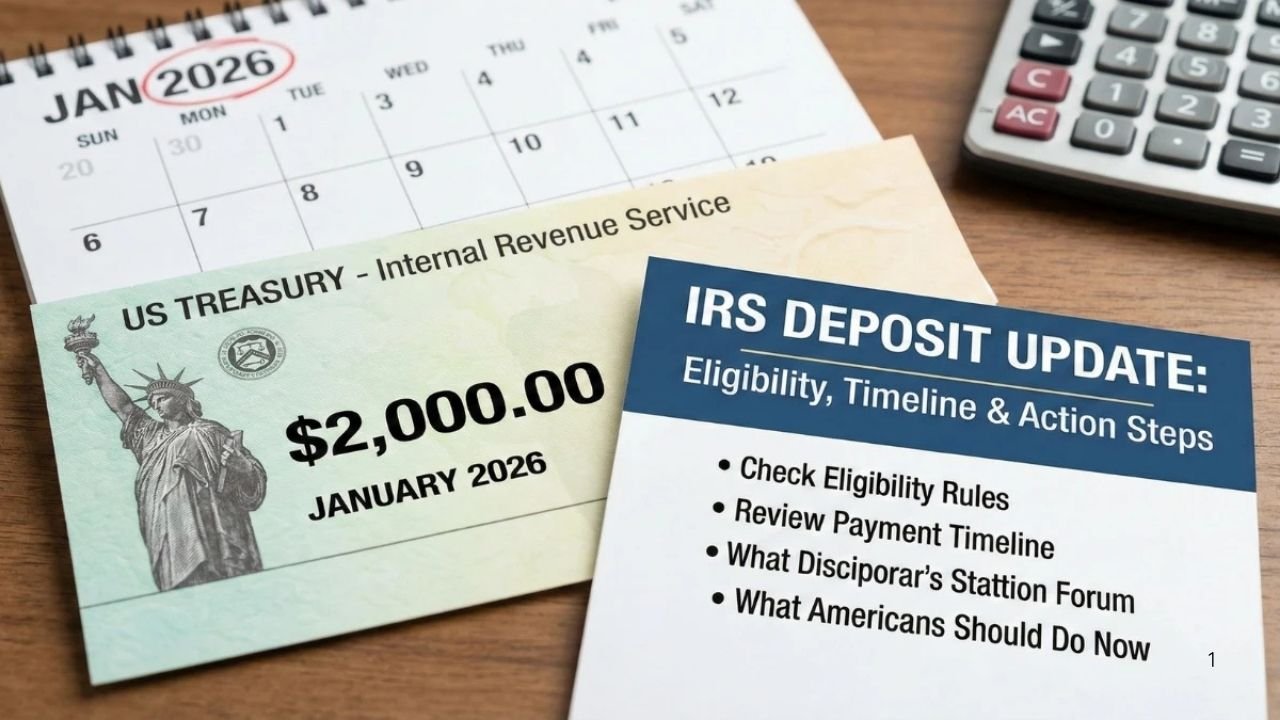
Talk of a $2,000 IRS deposit in January 2026 is spreading rapidly online, leaving many Americans confused and hopeful. However, it’s important to separate facts from viral claims. As of now, the Internal Revenue Service has not announced a universal $2,000 payment for all citizens.
Deposits close to $2,000 are real—but they are tied to specific tax situations, not a new stimulus program. This guide explains the reality behind the headlines, who may actually receive payments, and what steps taxpayers should take now.
Is a $2,000 IRS Deposit Official for January 2026?
There is no confirmed flat $2,000 IRS payment scheduled for everyone in January 2026. The IRS has not approved any nationwide stimulus or automatic deposit of this amount.
Payments near $2,000 typically come from:
- Federal tax refunds
- Refundable tax credits
- Amended return adjustments
- Corrections to prior-year benefits
These payments depend entirely on individual eligibility and tax filings.
Why Is the $2,000 Amount Being Mentioned So Often?
The $2,000 figure is commonly referenced because:
- It reflects the average refund range for many taxpayers
- Certain refundable credits can total close to $2,000
- Delayed refunds or corrections may arrive as lump-sum deposits
Online posts often mislabel these individual tax-based payments as “guaranteed IRS deposits,” which is misleading.
$2,000 IRS Deposit January 2026: Reality Check
| Topic | Official IRS Position |
|---|---|
| Universal $2,000 payment | Not approved |
| Automatic deposit for all | No |
| Fixed January payment date | Depends on filing & processing |
| Eligibility | Individual tax-based rules |
| Authority | IRS processes valid claims only |
Who May Actually Receive Around $2,000?
You may receive a deposit close to $2,000 in January 2026 if you qualify for one or more of the following:
- Refundable tax credits based on income and dependents
- Overpaid federal taxes resulting in a refund
- Amended tax return adjustments
- Delayed refunds from prior tax years
- Corrections to previously underpaid credits
Each case is reviewed individually, and amounts vary.
Eligibility Rules You Must Understand
Eligibility is determined by federal tax law, not automatic enrollment. To receive any IRS payment:
- A valid tax return or amended return must be filed
- Income, dependents, and filing status must qualify
- Identity and banking details must be verified
- Claims must be approved by the IRS
There is no one-size-fits-all amount.
IRS Payment Timeline Explained Clearly
IRS payments are issued only after processing is complete.
Key timeline factors:
- Direct deposit is the fastest option
- Electronic filing speeds up processing
- Errors or paper filings cause delays
- Manual reviews can extend timelines
Even if filed early, payment timing varies by case.
What Americans Should Do Now
To avoid confusion or delays, taxpayers should take practical steps now:
- File tax returns accurately and on time
- Use direct deposit for faster refunds
- Review IRS notices and correspondence
- Track refunds using official IRS tools
- Ignore viral posts promising guaranteed money
Only information published on IRS.gov should be trusted.
Key Points to Remember
- No confirmed universal $2,000 IRS payment
- Payments depend on individual tax eligibility
- Filing or claim submission is required
- Direct deposit speeds delivery, not approval
- IRS announcements are the only reliable source
Frequently Asked Questions
Is the IRS sending $2,000 to everyone in January 2026?
No. There is no universal or automatic $2,000 payment.
Why did someone receive close to $2,000?
Likely due to a tax refund, refundable credit, or adjustment.
Do I need to apply for an IRS payment?
Yes. A valid tax filing or approved claim is required.
Will everyone get paid in January?
No. Payment timing depends on when returns are processed.
Where can I verify IRS payment information?
Only through official IRS channels and notices.
Final Thoughts
The $2,000 IRS deposit January 2026 conversation is rooted in refunds and tax-credit-related payments, not a new stimulus program. Americans who meet specific eligibility rules and complete proper IRS procedures may receive deposits near this amount—but there is no guaranteed payment for all.
Staying informed, filing accurately, and relying only on official IRS updates is the best way to avoid misinformation and ensure you receive any money you are legally entitled to.